
Discover Léko Pro
Extended Producer Responsibility (EPR) for Professional Packaging
Extended Producer Responsibility (EPR) is based on a simple principle: companies that place products or packaging on the market must take responsibility for their end-of-life management. In this way, they contribute to the financing, collection, and recycling of the waste generated by their activities.
This system is based on Regulation (EU) No. 2025/40 on packaging and packaging waste (PPWR), which is aligned with national legislation, notably the Anti-Waste Law for a Circular Economy (AGEC, 2020), which aims to reduce waste generation, encourage reuse and recycling, and accelerate the transition to a more sustainable economy.
This legal framework gradually extends producers' responsibility to new categories of packaging, including commercial packaging, for which the effective date is set for January1, 2027.
The Extended Producer Responsibility (EPR) program for professional packaging (EPRO) covers all so-called “commercial” packaging: industrial, commercial, transportation, storage, and handling packaging used in B2B sectors (manufacturing, retail, logistics, food service, etc.). This includes, for example , plastic crates, pallets, plastic film, cardboard boxes, drums, cans, glass packaging for medical or veterinary use, and other items identified in the scope decree of December 2, 2025.
Who is concerned by the EPRO EPR?
Effective January 1, 2027, this new regulation EPR applies to all market operators — manufacturers, importers, and distributors—who place this packaging—or packaged products—on the French market.
Approximately 8 million metric tons¹ of professional packaging is placed on the market each year, compared with 5.5 million metric tons² of household packaging.
1 Figures from the ADEME feasibility study
2 Prefiguration-Sector-EPR-Industrial-and-Professional-Packaging-Summary-2024
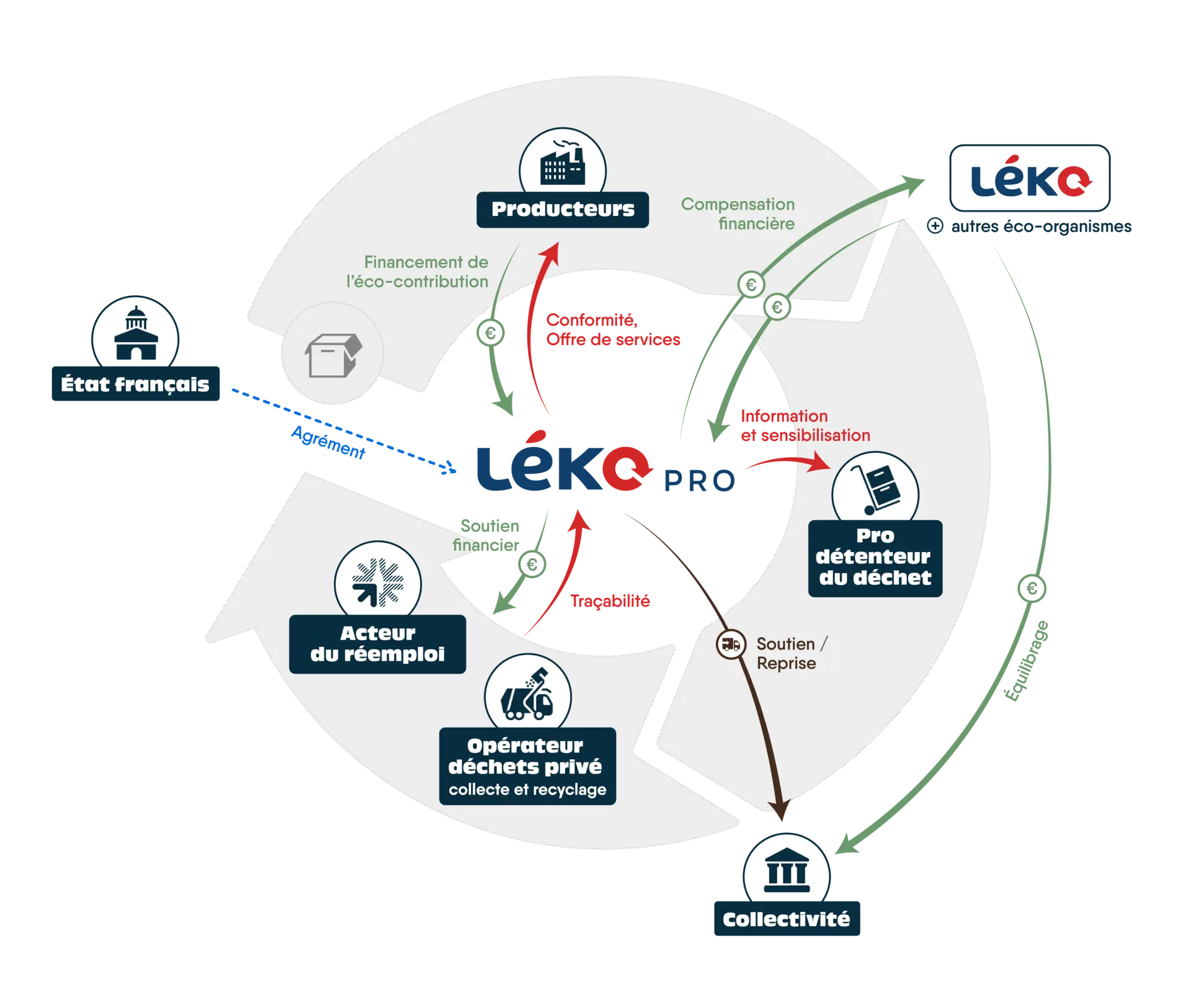
Léko Pro, a state-approved eco-organization
Léko Pro is an eco-organization accredited by the French government for the Extended Producer Responsibility (EPR) scheme for professional packaging (EPRO). Its mission is to assist the relevant companies (manufacturers, importers, distributors, and industrial firms) in ensuring compliance with their regulatory and environmental obligations.
Thanks to funding from eco-fees, Léko Pro simplifies the management of end-of-life packaging, optimizes collection processes, and contributes to material recovery. Léko Pro also develops tools and training programs to help companies adopt more sustainable practices, such as choosing recycled materials, optimizing logistics, and designing reusable packaging.
The Schedule of Obligations for Producers
Before January 1, 2027
Join an accredited eco-organization to ensure compliance as soon as the EPRO “ EPR ” takes effect. Submit your 2027 market launch projections when you join.
January–February 2028
File your actual income tax return for the period from January 1, 2027, to December 31, 2027.
Every year
Update your volumes, adjust your contributions, and help track the sector's performance.
The objectives set for the EPRO (Professional Packaging) sector
Reduction at the source: 5% of packaging placed on the market by 2030 compared to 2010;
Reuse: By 2030 (unless exempt, such as cardboard boxes), the goal is to use reusable packaging as part of a reuse system for:
-
-
- 40% for transport and sales packaging used in business-to-business trade within the EU
- 100% for shipping and retail packaging used for transport in trade within France and between the operator’s various sites and those of its partners
- 10% for boxed sets
-
Recycling: By 2028 (as specified in the technical specifications), achieve the following recycling rates by material:
-
-
- 75% for paper and cardboard
- 50% for plastics
- 70% for steel
- 50% for aluminum
- 25% for wood
- 70% for glass
-
by 2030 (PPWR):
-
-
- 85% for paper and cardboard
- 55% for plastics
- 80% for steel
- 60% for aluminum
- 75% for glass
- 30% for wood
-
These objectives are part of a broader approach to the circular economy and environmental performance, led by accredited environmental eco-organizations such as Léko Pro.